What changed, why it changed, and what I can prove
01
Category launch
Ran a launch event end to end for 36 senior marketers
Owned start to finish
The problem
A pre-seed company with no brand needed senior product marketing leaders in one room in San Francisco. That audience ignores vendor outreach, so the evening itself had to be worth their time.
What I owned
ProgrammedBuilt the night around a debate practitioners were already having about their own role, not a product pitch.
Recruited4 panelists, from Atlassian, Meta Reality Labs, Google, and a Celona, Google, and Zscaler background.
ProducedVenue, logistics, run of show, and promotion for November 11, 2025, with no events team.
ConvertedFollow-up that moved attendees into product conversations and the design partner program.
Messaging in market
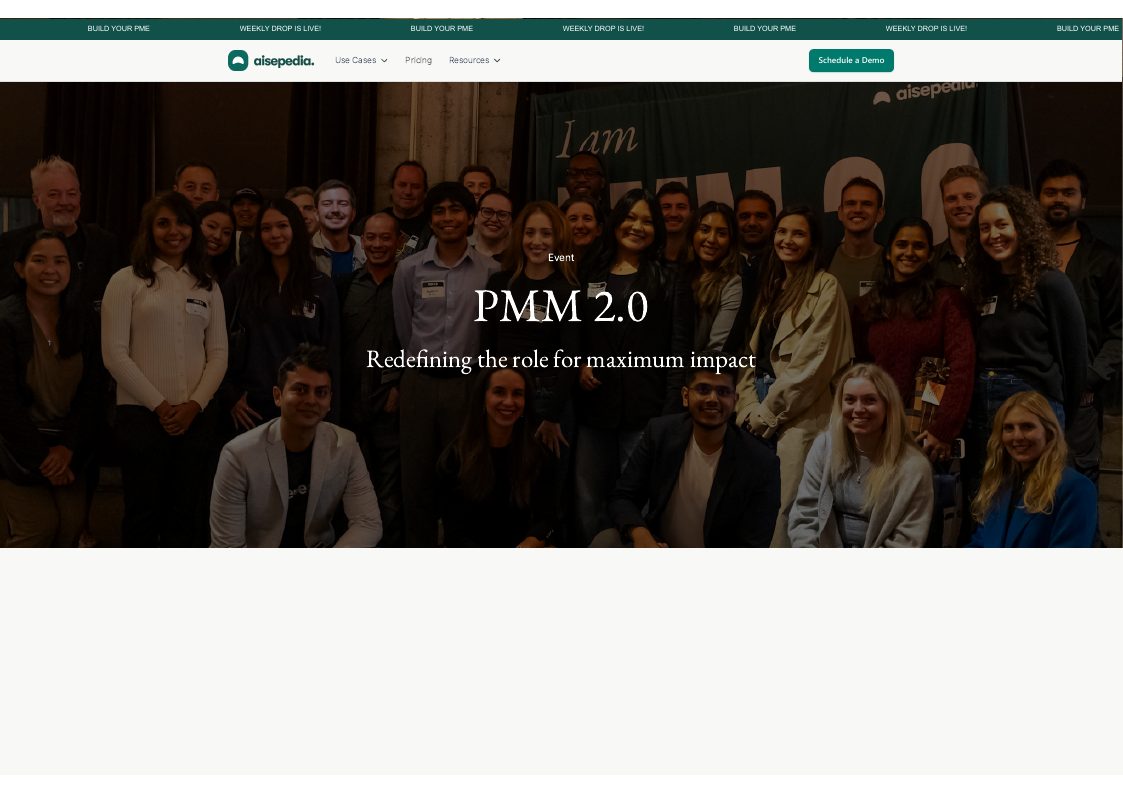
PMM 2.0: Redefining the role for maximum impact
Positioned around a debate practitioners were already having. The product stayed secondary to a room worth joining.
Built roughly $400K in qualified pipeline from a standing start
From no list to tracked pipeline
The problem
No brand, no list, no inbound, no SDR. Every one of 134 accounts had to be found, reached, and tracked by one person.
What I owned
Targeted134-account list built from a defined ICP, each tracked from first touch to qualification.
Reached1,000 targeted LinkedIn and outbound reach-outs over six weeks.
QualifiedResponses moved into discovery calls, demos, and the design partner program.
TrackedEvery account held in HubSpot, so pipeline read by stage, not by anecdote.
~$400K
in qualified pipeline
From 1,000 reach-outs and 20 first-cohort signups, with no paid media, no SDR, and no inherited list.
Qualified pipeline, not booked revenue. These are accounts that reached a defined qualification bar.
03
Design partner conversion
Turned 13 design partners into proof, panelists, and the first enterprise deal
From cold list to public advocates
The problem
A pre-seed product with no customers and no references. Senior practitioners had to be recruited cold, kept engaged, and then put their name to it in public.
What I owned
RecruitedBuilt a 13-member design partner cohort, 8 at Director level or above, from Atlassian, Splunk, Taboola, Dimagi, and Intuit.
Ran32 structured sessions on workflow, pain, trust, and buying criteria across 13 industries and 9 countries.
ActivatedPartners moved into public quotes, panel seats, and reference calls with prospects.
Converted1 design partner relationship became the first signed enterprise deal, Splunk (a Cisco company).
Positioning artifact
Built with you, not just for you.
The page made practitioners part of the product story, then backed it with named design partners.
4 practitioners carried the story onto the PMM 2.0 stage.
Splunk (a Cisco company) signed as the first enterprise deal, from a design partner.
04
Lifecycle instrumentation
Built the marketing operating system that runs the motion
Direct measured result
The problem
One marketer cannot chase every lead and still know what is working. Follow-up decayed during discovery calls, and nobody could say where people dropped out.
What I owned
AutomatedLead follow-up and lifecycle flows across n8n, HubSpot, and Calendly, so no inbound lead waited on me.
InstrumentedThe funnel wired end to end in Mixpanel and PostHog, so every drop-off had a location.
DiagnosedEach abandonment point mapped to a likely cause and a recovery action.
MeasuredLifecycle KPIs with warning thresholds for acquisition, activation, and retention.
24%
reduction in early-stage abandonment
Automated follow-up, instrumentation, onboarding changes, and recovery flows working together.
Built the reporting a multi-product subscription portfolio ran on
From revenue data to retention decisions
The problem
Leadership needed one set of numbers across renewals, expansion, wallet retention, product lines, and verticals. Marketing and sales were arguing over which accounts were at risk.
What I owned
BuiltDaily wallet-retention, weekly renewal, monthly MRR, and vertical-profitability reporting, read by the CEO, COO, and VP of Finance.
AnalyzedRenewal, expansion, product-line, and wallet-retention signals connected across the subscription book.
Surfaced$2.6M in recoverable ACV and $250K in monthly expansion potential, plus verticals slipping month over month.
Directed26,207 deal records and 21 account executives migrated to a new system with zero errors.
POLITICO figures were reported on and analyzed. They were not revenue I owned or closed.